


Unravelling the Mysteries of the Hinterkaifeck Murders: Germany's Chilling Cold Case
- Cailynn Brawffe

- Dec 15, 2025
- 5 min read

The snow had already fallen when the killer came to Hinterkaifeck. Footprints led to the farmhouse—but none led away.
Blood in the Snow
In late March 1922, deep in the Bavarian countryside, winter still clung to the fields. Snow blanketed the small settlement of Kaifeck, muting sound and turning the world ghostly white. On a lonely farmstead known as Hinterkaifeck, six people lived quietly; isolated, secretive, and perhaps already marked.
On April 4th, neighbors went looking for them. The Gruber family hadn’t been seen in days. The chimney no longer smoked, and the mail had begun to pile up. What they found inside would become one of Germany’s most haunting unsolved crimes, a mystery still whispered about more than a century later.
As described in The True Crime Database’s detailed account of the Hinterkaifeck murders, investigators found the bodies of six people, four in the barn, two in the house, each slain with a mattock, a farming tool meant for breaking earth, not bone. The killer had covered them neatly with hay and boards, as if tidying up after the act.
But what chilled police most wasn’t the brutality, it was what came after. The family’s livestock had been fed, food cooked, and smoke rose from the chimney for days following the murders.
It seemed someone had stayed, living among the dead.
The Gruber Family and Their Secrets
The victims were the Gruber family, Andreas and Cäzilia, an aging couple known for their sternness; their widowed daughter Victoria Gabriel; her children, seven-year-old Cäzilia and two-year-old Josef; and Maria Baumgartner, the maid who had arrived that very day.
Andreas was feared by neighbours. He was hard, suspicious, and reportedly cruel. Victoria was pious but not without scandal; villagers whispered that her father, Andreas, might also be the father of her youngest child.
The Grubers’ farmhouse stood far from town, half-swallowed by forest. It was quiet, too quiet.
“A place where sound carried but no one listened,” one villager would later say.
The Days Before the Murders
The final week of March brought unease.
Andreas told his neighbors he had found footprints in the snow leading to the house, but none leading away. He heard footsteps in the attic at night, though searches turned up nothing. Keys disappeared. A newspaper appeared in the kitchen that no one had bought.
According to Mental Floss’s chilling retelling of the Hinterkaifeck killings, the Grubers had begun sleeping in one room, afraid to separate. But by the time anyone took their fears seriously, it was too late.
On March 31, the new maid, Maria, arrived. Hours later, she was dead — her first night on the farm her last.
The Murders at Hinterkaifeck
Sometime that evening, four family members, Andreas, Cäzilia Sr., Victoria, and little Cäzilia, were lured to the barn one by one. Each was struck multiple times with the mattock. The blows were deliberate, efficient.
Inside the house, the maid Maria and toddler Josef were killed next. Their bodies were covered gently, as though by someone performing a ritual of shame.
Days later, when the neighbors entered the barn, they found the bodies stacked beneath hay, the air heavy with decay and silence. The house was eerily tidy. Milk had been poured. Bread had been sliced. Someone had lived there, calmly, after the massacre.
“He didn’t just kill them,” a local police report noted. “He took their place.”
The Discovery
On April 4th, concerned neighbors arrived at Hinterkaifeck. Inside the barn, they found the Grubers and Victoria’s daughter, buried beneath straw. Inside the house, Maria and Josef lay still in their rooms.
The police investigation that followed was disastrous. Curious villagers trampled through the scene. The bodies were moved before photographs could be taken. Important evidence was burned for “sanitation.”
It was chaos in the snow.
“By the time help arrived,” one investigator later said, “the killer had already vanished into legend.”
The Suspects and Theories
The Hinterkaifeck murders spawned more than a hundred theories, none conclusive.
Lorenz Schlittenbauer
A neighbour and Victoria’s rumoured lover, Lorenz, was the first to find the bodies. His behaviour that day, entering the home, feeding the animals, acting as though the farm was his, raised suspicion. Yet, despite being interrogated multiple times, he was never charged.
A Crime of Shame or Revenge
Others believed the motive lay in the family’s scandalous history. Andreas and Victoria had once been convicted of incest, and many villagers believed baby Josef was Andreas’s child. Perhaps someone acted out of vengeance or moral rage.
The Drifter Theory
Robbery was dismissed almost immediately — money and jewelry were left untouched.
The Phantom in the Attic
The most enduring theory, and perhaps the most chilling, suggests the killer had been living in the house before the murders. The missing keys, the attic noises, the unfamiliar newspaper; all signs of someone watching from above, waiting.
Investigators concluded that whoever did it knew the farm, the routines, the family. It was no stranger. It was someone close.
The Legacy of Hinterkaifeck
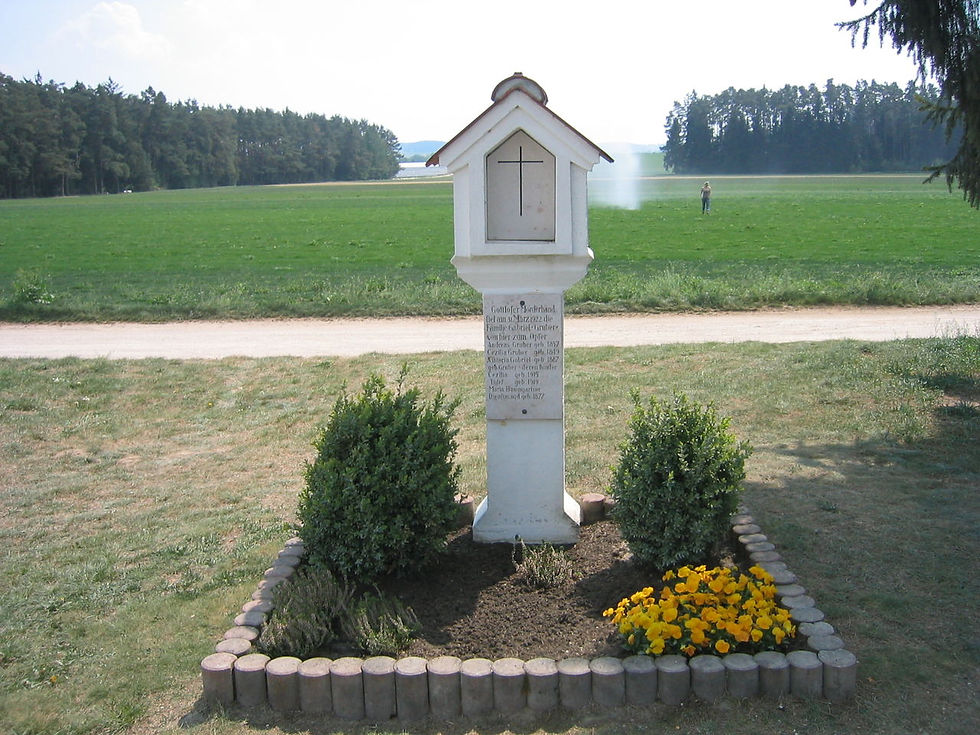
The farmhouse was demolished in 1923, but the story clung to the soil like blood in the snow.
Today, a small memorial marks the spot. Visitors leave candles, coins, and small flowers. Locals rarely go near it. Some say they hear footsteps in the field, others claim to see flickering light where the barn once stood.
The case continues to fascinate true crime historians and paranormal researchers alike. As noted in the True Crime Database’s case analysis, the investigation has inspired dozens of books and films, from Tannöd to modern documentaries.
A hundred years later, the question remains the same: who killed the Grubers — and why did they stay?
“The snow melted,” one journalist wrote, “but the footprints never left.”
The Silence Between Footsteps
The Hinterkaifeck murders are terrifying not because of what we know, but because of what we don’t. There was no robbery, no confession, no resolution; only silence.
The killer wasn’t a phantom from folklore, but something far worse: a person with patience.
They stayed. They slept there. They lived among the bodies, keeping the illusion of life alive for days.
It’s the kind of horror that hides beneath the ordinary. The creak in the attic. The missing key. The feeling that someone’s behind you when you turn out the light.
And maybe that’s why Hinterkaifeck still grips us a century later because it whispers the one truth no one wants to face:
Evil doesn’t always knock. Sometimes, it moves in.


Comments