


The Legend of La Patasola: Unravelling the Macabre Mystery

Some stories are told to frighten children.
Others are told to keep adults in line.
They persist not because they are entertaining, but because they are useful because they explain disappearances, justify fear, and give shape to anxieties that would otherwise have nowhere to go. In places where the forest presses close and paths thin into guesswork, folklore does more than entertain. It watches. It warns. It waits.
La Patasola is one of those stories.
The Shape That Moves Incorrectly
There is a particular wrongness that announces itself before it can be named. A figure, ahead on the path, paused between trees. Still. Familiar. Human enough to register as harmless.
It’s only when she moves that the mind begins to resist what the eyes insist on seeing. The gait is uneven. Not limping, exactly, more like remembering how walking works and failing to care if it’s convincing.
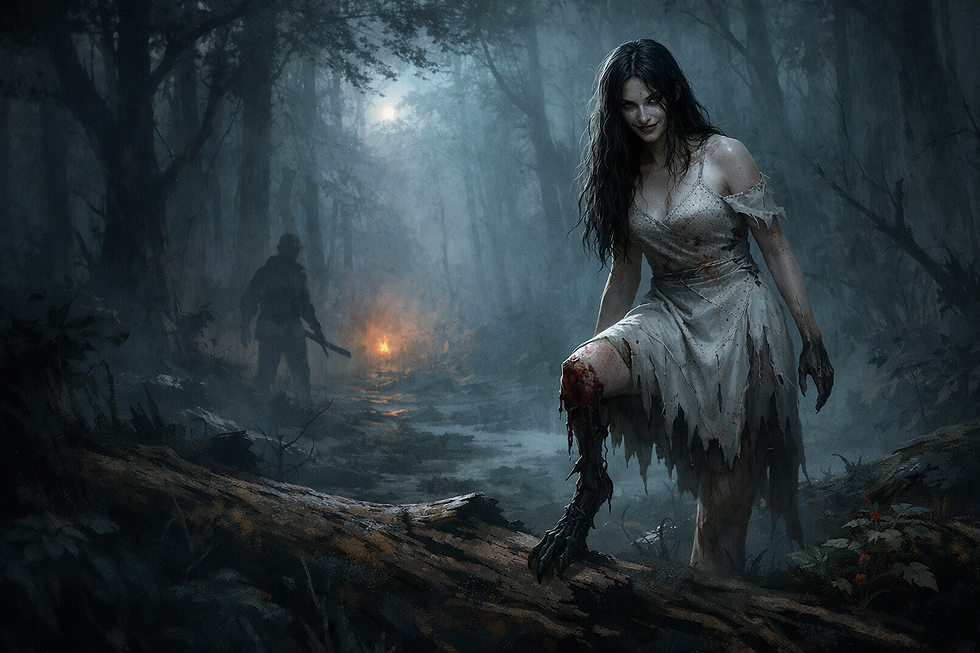
You notice the forest first, then her. The way the light fractures through the canopy. The sound of insects stopping, as if something has interrupted the script. You feel watched without knowing from where. When she turns, you see a woman, young, beautiful, composed.
And yet, your body is already preparing to leave.
A Story Told Where Distance Matters
In parts of Latin America, the figure has a name: La Patasola. She appears to lone travellers, most often men, in jungles and forests where isolation is not metaphorical but physical. She draws attention by being ordinary, by offering company where there should be none.
Only later does the truth assert itself. She has one leg.
Sometimes the leg ends in a stump.
Sometimes in a hoof.
Sometimes it is simply wrong, like an unfinished thought.
These stories are not told with urgency or spectacle. They are passed down quietly, the way instructions are. A warning disguised as narrative.
Don’t follow.
Don’t trust what looks easy.
Don’t assume the forest belongs to you.
Where the Story Comes From
Long before she became a figure of horror, La Patasola belonged to oral traditions rooted in rural Colombia and neighbouring regions. These were working landscapes, plantations, jungle paths, river crossings, where people travelled alone and help did not arrive quickly, if at all.
The stories shifted with each telling. Details changed. Motives blurred. What remained was the setting: places beyond the reach of witnesses, where rules thinned out and consequences became permanent.
A Legend Shaped by Punishment
In many versions, La Patasola was not born monstrous. She was made so. Her transformation follows a familiar pattern: a woman who transgresses, through infidelity, defiance, or sexual autonomy, is punished through bodily alteration. Her leg is taken. Her movement restricted. Her humanity rewritten.
The crime varies. The sentence does not.
This kind of narrative was common. Folklore provided a way to enforce behaviour without naming power directly. By turning punishment into myth, the violence behind it became inevitable, even instructive.
Why the Forest Keeps Her
The forest is not incidental. It is where labourers travelled alone, where men crossed boundaries without witnesses. By placing La Patasola there, the story performs two functions at once: it warns men against recklessness, and it removes a “disobedient” woman from society entirely.
She is exiled into the wild, where she becomes a presence rather than a person.
When Folklore Becomes a Sentence
The longer the story lingers, the more uncomfortable its warning becomes. Because La Patasola is not simply a predator.
She is a punishment.
The Body as Evidence
Her body becomes the lesson.
Desire leads to danger.
Independence ends in mutilation.
Beauty must be balanced with consequence.
The horror does not lie in what she does to others, but in what was done to her first. Her missing leg is not just a detail, it is proof. A visible mark that turns a woman into a warning.
The forest becomes the stage where these anxieties play out safely. A place where men are made vulnerable, yes, but where women who step outside prescribed roles are rendered monstrous enough to justify fear.
Monsters Who Do Not Chase
What makes La Patasola unsettling is not violence, but restraint.
She does not chase in the way monsters are supposed to.
She does not roar or bare her teeth.
She waits. She smiles. She lets you make the mistake yourself.
The story does not ask you to fear her.
It asks you to consider why she exists.
The Incomplete Body
There is something deeply uncomfortable about a figure whose threat lies in being unfinished. The missing leg signals that she has been made less in order to be contained.
She does not move correctly.
She does not behave correctly.
She does not exist for the comfort of the person observing her.
And that is precisely why she unsettles.
Seeing La Patasola Too Late
In the end, the forest always closes in.
The path narrows.
The distance between curiosity and danger collapses.
By the time you understand what you are looking at, it is already too late to pretend you didn’t see it. The wrongness was there from the beginning.
You simply chose not to recognise it.


Comments